
Updated: May 23
Curriculum
Using the lesson plan format used by the Grade 7 mathematics teacher, my teaching plan was aligned with the Cambridge Curriculum, which is the curriculum used by Lazuardi Ibnu Sina Kendari for teaching Mathematics. In fact, the textbook used by the Grade 7 students and teacher is called Cambridge Lower Secondary Mathematics, authored by Dr. Toh Tin Lam, and this is where most of the content and examples provided in my lesson plan came from.
Interestingly, the Cambridge Curriculum is a well-known advanced international education framework developed to improve learners’ conceptual understanding, critical thinking, and real-life problem-solving skills. Therefore, aside from the school’s philosophy, I made sure that my teaching plan aligns with this goal and vision of the Cambridge Curriculum, teaching not just conceptual understanding but also designing and implementing activities that encourage critical thinking and problem-solving.
Mathematics Teaching Plan
Behind every successful instruction and teaching demonstration is a teaching and lesson plan that structures the teaching, learning, and assessment processes and activities, aligning them with the learning objectives. Without this written curriculum, the instruction would not be as creative, organized, and effective. Therefore, it is important to have a well-designed teaching plan that ensures student participation, effective technology integration, objective-driven assessments, and an effective teaching and learning process.
Before I share my specific teaching plans, I have a short experience to tell. For my entire teaching practice in Lazuardi Ibnu Sina Kendari, I was able to teach four times, not just once or twice. My first two teaching experiences were unplanned and unexpected, as I was just given on-the-spot teaching chances by my cooperating teacher, which happened during the observation and teaching assistantship weeks. That means that in those teaching experiences, I did not prepare lesson plans. It is because they were unexpected teaching opportunities, which challenged me to be flexible and adaptive.
Now during the teaching demonstration week was my third and fourth times teaching in the school: my initial and final teaching demonstrations. This time, I was required to create teaching plans. The lesson plans I crafted were aligned with the lesson plan format provided by my cooperating teacher, as well as with the Cambridge Lower Secondary Curriculum. I also integrated some of the teaching strategies and practices that I normally do in the Philippines.
The mathematics lesson plan I used for my initial and final teaching demonstrations in Lazuardi Ibnu Sina Kendari consists of the following teaching process components:
1. Introduction
2. Concept Delivery
3. Guided and Independent Practice
4. Closing and Reflection.
Meanwhile, in the Philippines, mathematics lesson plans used by secondary public schools normally have the following parts of the teaching process:
1. Classroom management / Preliminary activities
2. Reviewing previous lesson or presenting the new lesson
3. Establishing a purpose of the lesson
4. Presenting examples/instances of the new lesson
5. Discussing new concepts and practicing new skills #1
6. Discussing new concepts and practicing new skills #2
7. Developing mastery
8. Making generalizations and abstraction about the lesson
9. Finding practical applications of concepts and skills in daily living
10. Evaluating learning
11. Additional activities for application or remediation
As you can see, there is a noticeable difference between the two lesson plans. The lesson plan in Lazuardi Ibnu Sina Kendari is broader, simpler, and more flexible. Meanwhile, the lesson plan format used in public secondary schools in the Philippines is more structured and detailed.
Initial Teaching Demonstration: Adding and Subtracting Algebraic Expressions


Slide Presentation: https://canva.link/xqxmczk5rtggjxz
The document above is the lesson plan I crafted for my initial teaching demonstration in Lazuardi Ibnu Sina, where I taught the Grade 7 Mathematics topic, Adding and Subtracting Algebraic Expressions. I designed a lesson plan that applies direct instruction, guided practice, guided discovery, and collaborative learning to ensure that my students will better understand the mathematics lesson, practice their skills in problem-solving, and maximize their learning experiences.
I. INTRODUCTION
The following is the sequence of activities or procedures that I planned for the introduction section of my first teaching demonstration:
1. Greeting and Prayer
2. Attendance and Preparation
3. Classroom Rules

4. Warm-up / Review Activity: Find the Like Term!
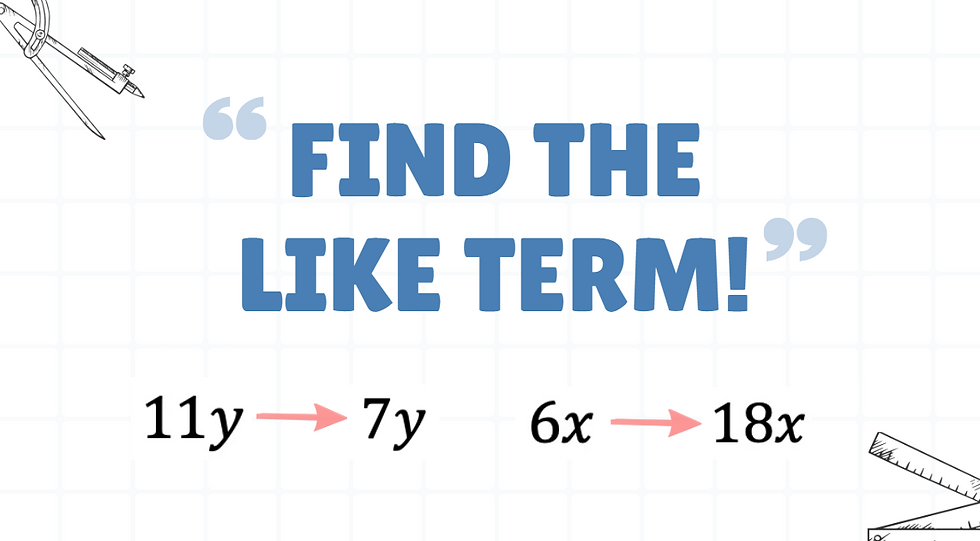
The teacher shows a monomial, and the students should raise a matching card to form like terms.
5. Learning Objectives

6. The Hook Activity: Fruit Challenge

The students are tasked to analyze an activity to realize that only like fruits or items can be combined, which will introduce the concept of like terms in adding and subtracting algebraic expressions. This is a guided discovery approach because students don’t have to solve, but analyze and extract the key idea, promoting critical thinking and conceptual understanding to students.
II. CONCEPT DELIVERY & GUIDED AND INDEPENDENT PRACTICE
Considering my assessment of Grade 7 students’ mathematical competence after having opportunities to observe and assist their class, I planned to implement direct instruction followed by guided practice for teaching algebraic solutions. To ensure learning, they need a teacher who explains and shows the concepts and the solution process first, as well as one who allows them to practice solving with guidance afterwards. That is why, for teaching how to add algebraic expressions, I intended to teach them the rules and show them the step-by-step solutions first. This will allow students to gain an understanding of the topic and solution process, ask questions to clear up confusion, and have a clear foundation for solving similar problems before they start or practice solving. Once they understand how to perform each type of addition of algebraic expressions, they can now practice solving and ask for guidance from the teacher when needed.


That is also the instructional technique I designed for teaching them how to subtract algebraic expressions, as well as how to solve word problems involving addition and subtraction of algebraic expressions under the Concept Delivery part of the lesson plan.


Finally, under the Guided and Independent Practice part, a collaborative approach is designed to share, strengthen, and showcase students’ knowledge and skills in adding and subtracting algebraic expressions through collaborative real-world problem solving titled Stationery Distributor. While they are doing their group tasks, the teacher aims to guide each group. Students’ outputs, as well as their presentations afterwards, would demonstrate what they learned and how much they mastered the topic. This activity would also help them grasp better the real-life relevance of the lesson. Additionally, to ensure accuracy and learning, I planned to provide feedback, as well as reveal and explain the correct answers and solutions afterward.

After gaining experience in adding and subtracting algebraic expressions, including their practical application, the students are now capable of answering an individual summative activity, which is aligned with the learning objectives and topics taught.

III. CLOSING AND REFLECTION
The closing and reflection section of my initial teaching plan consists of two parts:
Reflection
The students will reflect on how they feel after studying, what they have learned, and what difficulties they have encountered.
Prayer
The students will pray before the session ends.
Final Teaching Demonstration: Simplifying Algebraic Expressions


Slide Presentation: https://canva.link/z4kn1x9q9eongrn
The document above is the lesson plan I crafted for teaching the Grade 7 Mathematics topic Simplifying Algebraic Expressions. To ensure that my students will better understand the mathematics lesson, practice their skills in problem-solving, and maximize their learning experiences, I crafted a lesson plan that applies direct instruction, guided practice, guided discovery, collaborative learning, and an interactive online manipulative tool.
I. INTRODUCTION
The following is the sequence of activities or procedures that I planned for the introduction section of my final teaching demonstration:
Greeting and Prayer
Attendance and Preparation
Classroom Rules

Warm-up / Review Activity: Stretch It Right!


The students answer a live multiple-choice question review questions one at a time by stretching their arms in different directions that correspond to the letter of their chosen answers.
5. Learning Objectives

The Hook Activity: Algebra Tiles Puzzle

The class will be divided into two groups and has to simplify algebraic expressions using an algebra tiles puzzle as shown below. Through this guided discovery activity, which promotes active learning, critical thinking, student engagement, and problem-solving, students should realize that algebraic expressions can be reorganized and expressed in simpler form.
II. CONCEPT DELIVERY & GUIDED AND INDEPENDENT PRACTICE
For this new lesson titled Simplifying Algebraic Expressions, I planned to apply almost the same teaching methods and strategies, including direct instruction, guided practice, guided discovery, and collaborative learning, with the integration of an interactive online manipulative tool. For students to have a better understanding of simplifying algebraic expressions involving addition and subtraction, which is the first subtopic of the lesson, direct instruction is designed to use, where the teacher directly shows to the class how to simplify algebraic expressions and explains the step-by-step solutions.

But this time, there is a colorful twist! After each example, Algebra Tiles, which is an online tool, will be used to visually represent and simplify those algebraic expressions, which provides an alternative and additional solution method, at the same time, makes the learning process less abstract and more visual and interesting to students. This technology integration through an interactive online manipulative tool can boost student interest and improve their learning, especially the visual learners.


Afterwards, collaborative learning will be applied through a pair work practice, where students simplify algebraic expressions by pair. It is a pair-work practice to promote teamwork and allow learners to assist one another in understanding and carrying out the process of simplifying such mathematical expressions.

This combination and sequence of direct instruction, interactive online manipulative tool, and collaborative learning is also designed for teaching the second subtopic Simplifying Algebraic Expressions Using the Distributive Law.


Similarly, a collaborative approach will be applied for learners to share, improve, and demonstrate their understanding and skills in simplifying algebraic expressions through a real-world problem-solving group activity. Their work, as well as presentation of outputs would show their understanding and mastery in simplifying algebraic expressions. This collaborative activity would also help them grasp better its real-world importance. And to ensure accurate answers, learning, and understanding, the teacher provides comments and reveals and elaborate the correct solutions and answers.

Consequently, after the discussion, as well as pair and collaborative activities, students answer a summative activity directly aligned with the learning objectives. This enables them to practice better, as well as the teacher to monitor and record their learning progress.

III. CLOSING AND REFLECTION
The closing and reflection section of my final teaching plan consists of two parts:
Reflection
The students will reflect on how they feel after studying math, what they have learned, and what difficulties they have encountered, and what their suggestions are.
Prayer
The students will pray before the session ends.
Others
I faced some challenges in preparing my teaching plans. First, I have to familiarize myself with the provided format and make sure that everything I include in each part is accurate. I have made some adjustments and incorporated some elements that I usually include in my teaching plans to make the teaching and learning experiences more creative, interactive, and relevant.
For my initial teaching demonstration, I was having a hard time understanding the provided lesson plan template, as it was very different from what I was used to. That is why I took a lot of time crafting that teaching plan. On the other hand, during my lesson plan preparation for my final teaching demonstration, I now have the necessary familiarity and understanding, so crafting it was not as challenging as it was. But it still took me so much time to develop it because I wanted my final teaching demonstration to be creative, enjoyable, adaptive, and interactive.
For the improvement of my teaching plan for my final teaching demonstration, I have my lesson plan checked by my cooperating teacher. Surprisingly, he said that it was well-crafted and does not need further revisions. He just wished me good luck and reminded me to make sure that the plan was implementable for one session.